
Recency and relevance win citations. Popularity doesn’t.
When large language models (LLMs) talk about a brand, they don’t just use that brand’s site. They scour reviews, listicles, social media posts and more. Marketers, then, need to get their brands mentioned on more than just their own sites to improve AI visibility.
Each AI model draws from different sources to different degrees, but on Google AI Mode and Google AI Overviews, social media is a channel that punches above its weight. Marketers can use influencers and owned pages on social media sites, especially YouTube, to get their brands mentioned more frequently, more accurately and in more contexts in models’ responses.
However, the metrics that matter to overall search visibility and social media algorithms — metrics like views, likes, comments and channel subscribers — are mostly irrelevant to AI citations, our analysis found. Rather, the only video traits associated with high AI citations were how closely a video’s title and description match the topic of the prompt and how recently the video was published.
Our findings suggest that using social media to drive AI visibility is a strategy most likely to work on Google AI Mode and Google AI Overviews, and marketers should focus on YouTube channels that consistently post videos on topics relevant to their brand. Furthermore, marketers should avoid overpaying for influencers with massive audiences if their goal is simply to improve AI visibility. Placing several bets across many channels would be a more effective strategy.
- Where: Google AI Mode and AI Overviews cite social most.
- Which: YouTube is the social lever worth pulling.
- How: Publish often, on topic. Skip the mega-influencers.
Google’s AI surfaces lean on social media the most
When responding to users’ prompts, AI models can answer based on only what they learned during training or they can incorporate internet searches, a process known as retrieval augmented generation. Models often opt for the latter, searching far and wide on any crawlable source.
Each model has its own preferences for what sources to use, preferences that are shaped by model training and engineering, as well as the crawling permissions sites choose to give each model. These preferences can change over time as model makers roll out new model versions.
At Evertune, we regularly track models’ preferred sources for various topics by running millions of prompts a day. For this analysis, we ran prompts about 70 different topics spread evenly across five categories: auto, B2B SaaS, finance, pharmaceuticals and travel. The prompts were repeated multiple times a day from June 1, 2026 to Oct. 1, 2026. Each topic had 55 unique prompts. In total, we amassed almost 8 million responses across six large language models (LLMs).
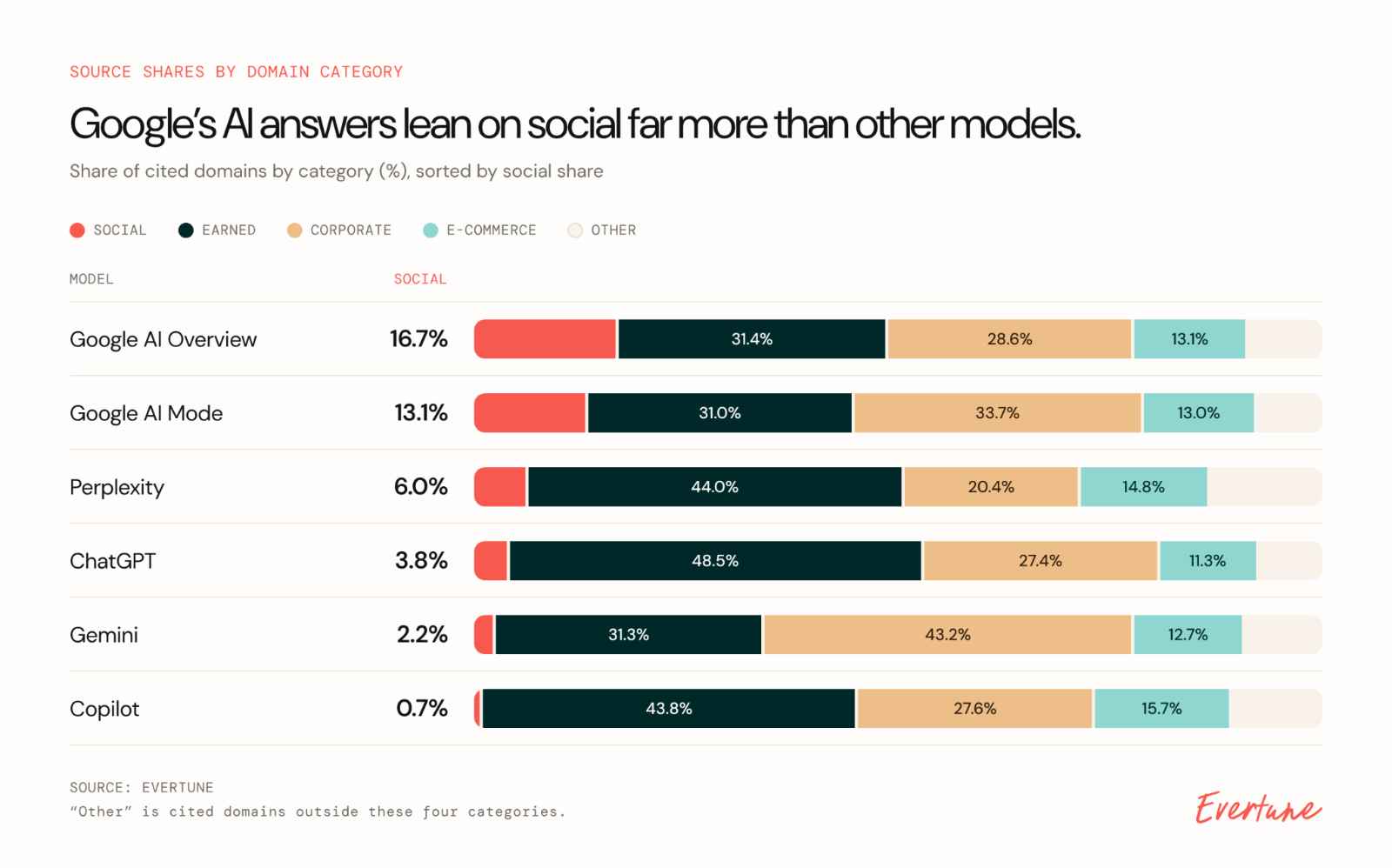
Of these six LLMs, social media domains were most cited by Google AI Mode and Google AI Overviews at 13% and 17% of citations, respectively. Copilot cited them the least at less than 1% of citations.
Two domains take nearly all the citations
There are many reasons marketers should care about Facebook, Instagram, TikTok and X. AI visibility, though, isn’t one of them.
AI models mostly cited just two domains: YouTube and Reddit. The pair accounted for 70–82% of models’ social media citations, excluding Copilot, which did not meaningfully cite either domain.
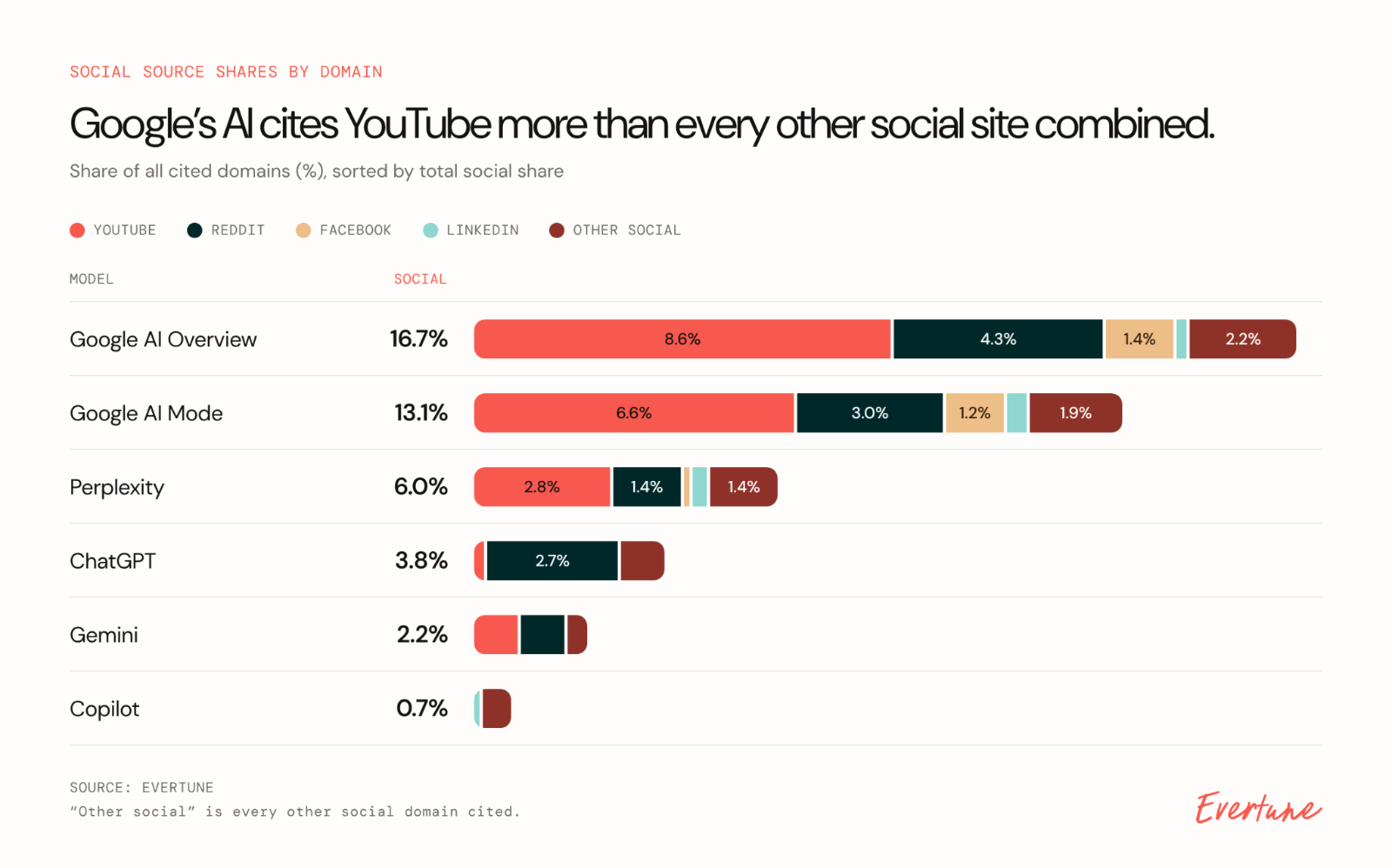
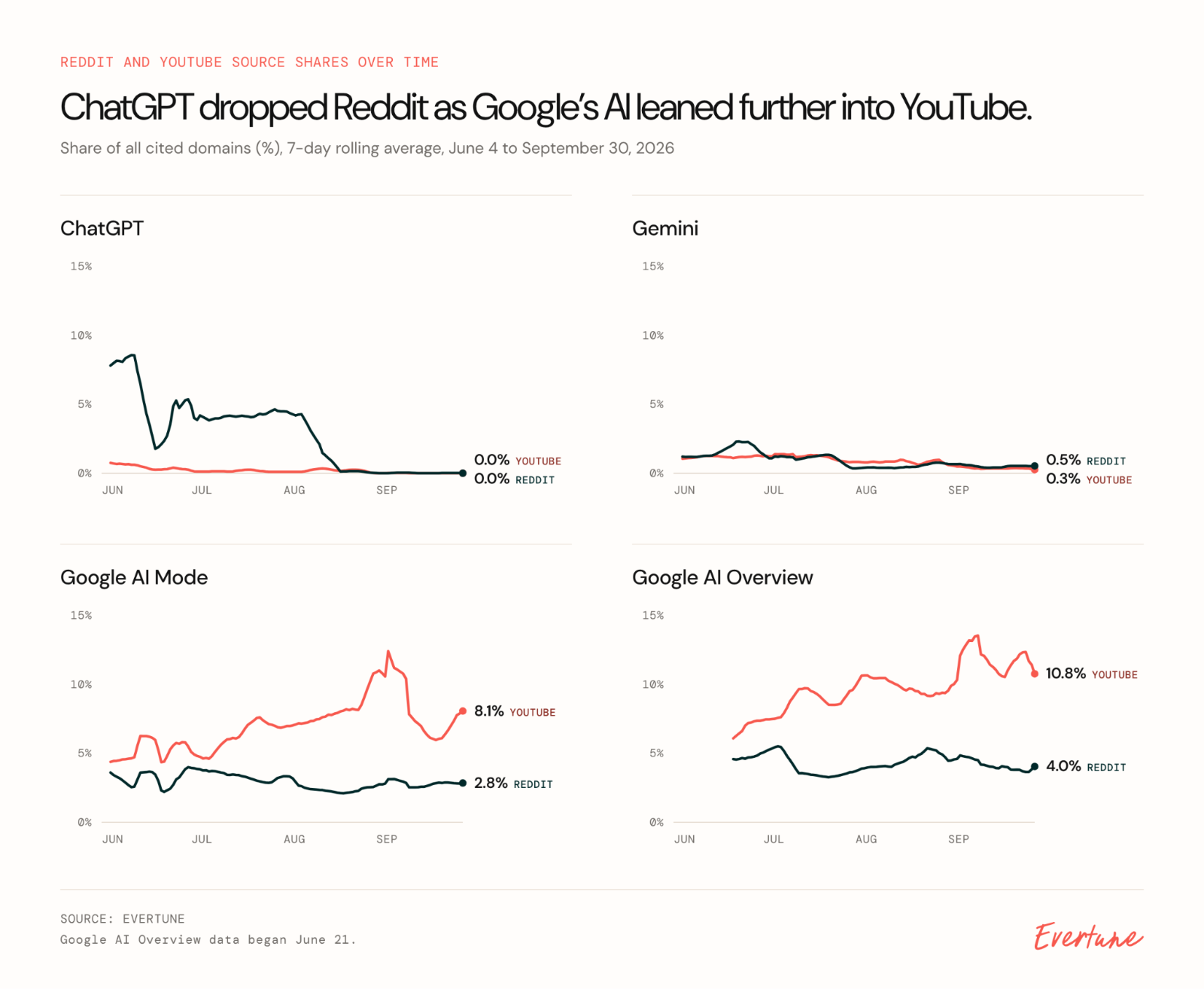
YouTube was by far the most cited social media domain on Google AI Mode, Google AI Overview and Perplexity, and its share is growing on the Google models. Its share of citations grew about four percentage points on Google AI Mode and five percentage points on Google AI Overviews from June through September.
Reddit was the most cited on ChatGPT over the four-month period studied, but ChatGPT’s use of the domain plummeted to near zero in August. Google AI Mode’s use of Reddit has tapered off as well, though not nearly as drastically as ChatGPT’s.
Although Reddit remains among the most-cited domains on Google AI Mode, Google AI Overview and Perplexity, YouTube has been the most-cited domain on Google AI Mode and Google AI Overview for three consecutive months and boasts significantly more citation share than Reddit in every category we analyzed.
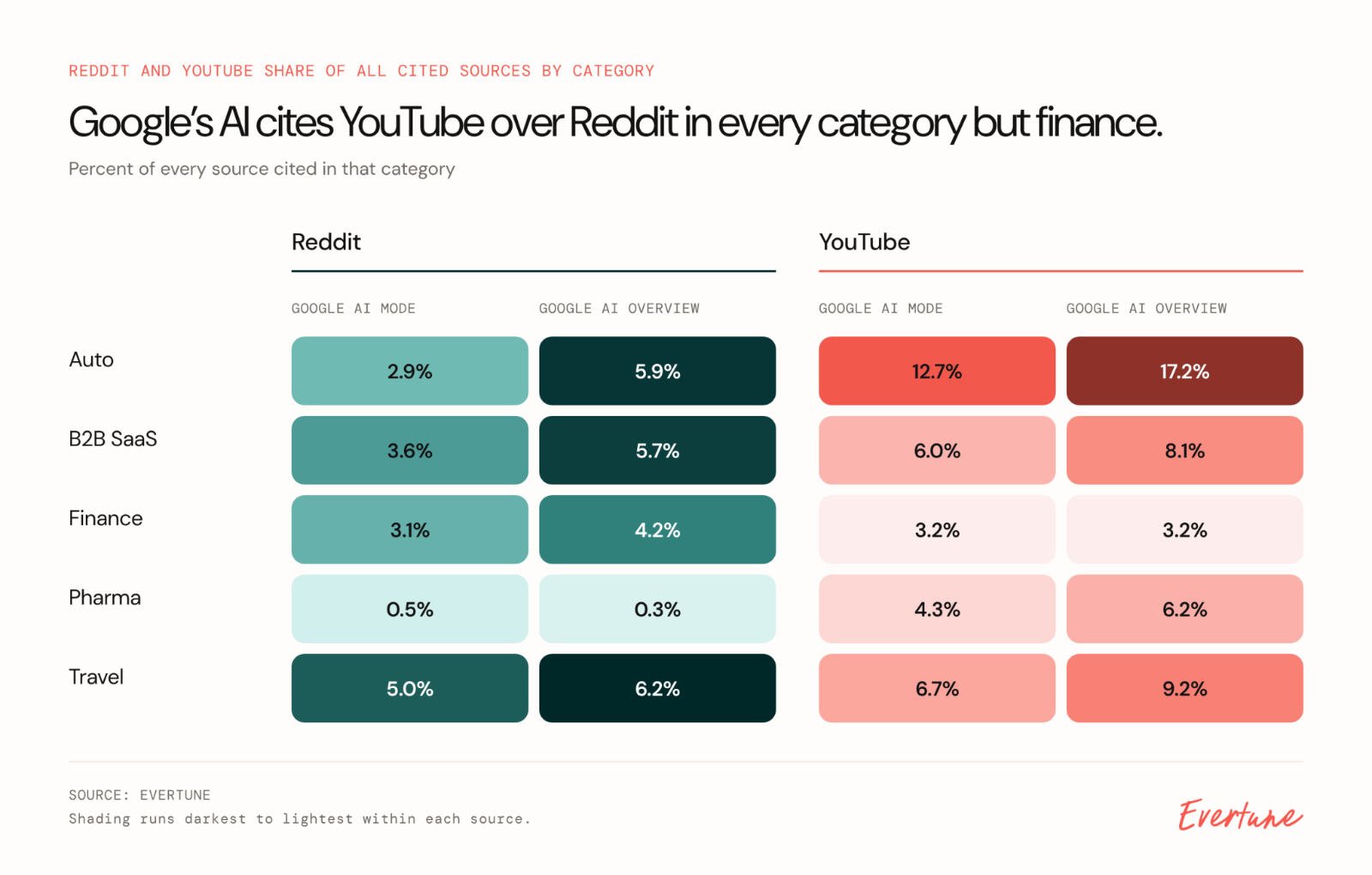
YouTube, then, is clearly the social media lever marketers want to pull to improve AI visibility.
Of 17 video traits, only relevance and recency mattered
To understand why AI models cite one YouTube video more than another, we analyzed 17 video traits using data retrieved from YouTube’s data API. The vast majority had no impact on how frequently a video was cited.
Among the video traits that AI models ignored were every signal of a video’s popularity, including its views, likes and comments and the number of subscribers of the channel that posted it. A video’s length and number of tags similarly had no effect.
Methodology
For our analysis, we evaluated every video cited by each model July–September. We compared videos within the same prompt and model contexts to ensure the differences in citation share were strictly due to the differences in the videos.
We used statistical models to measure which video and channel traits correlated with videos’ citations, where videos’ citations were ranked in percentiles, 1–100, to account for the fact that citation counts vary significantly by model. Keep in mind that correlation does not necessarily mean causation and that we quantified which video and channel traits relate to more citations among videos that are cited, not whether a video is cited or not.
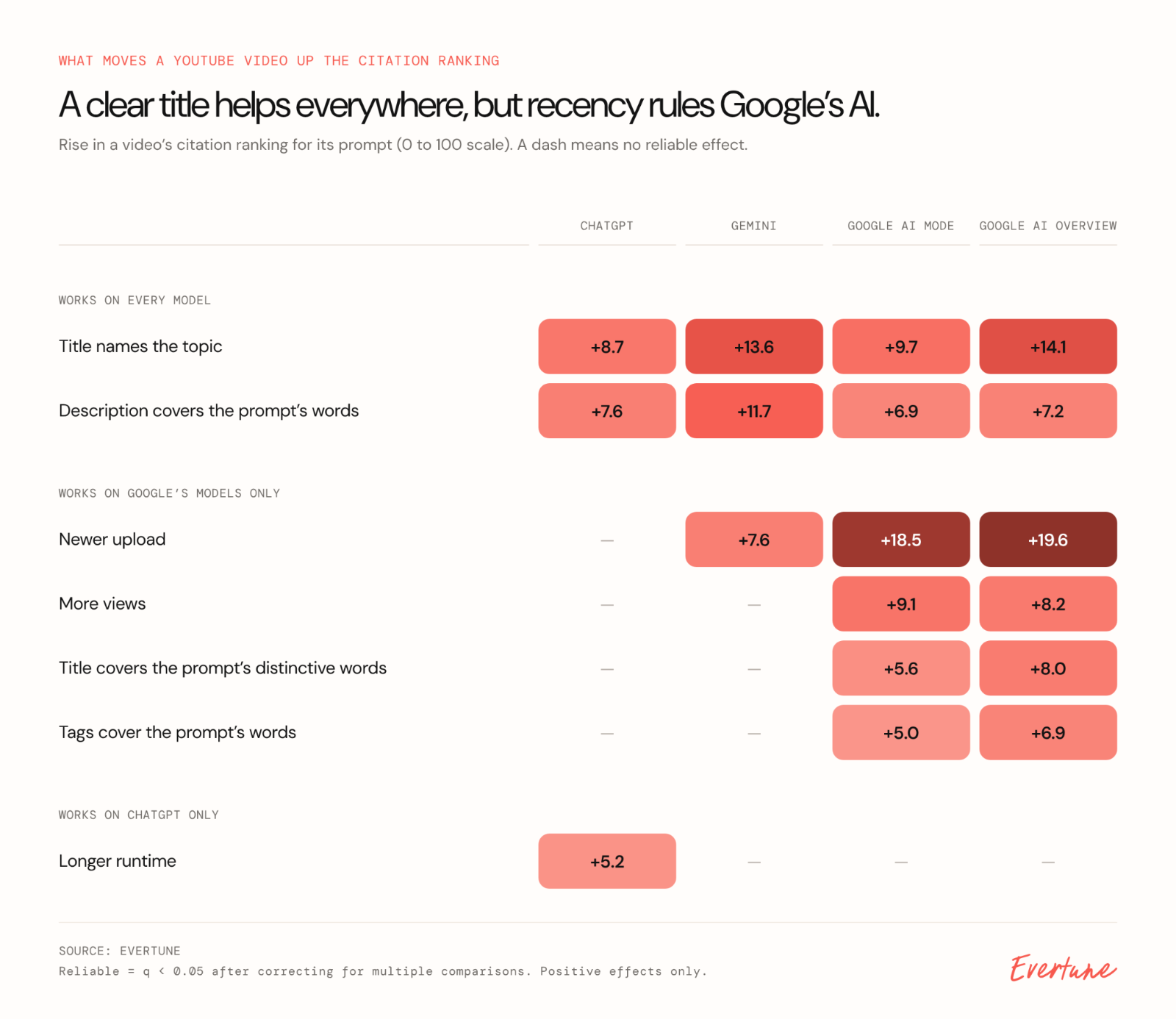
Across the four models we tested — ChatGPT, Gemini, Google AI Mode and Google AI Overview — the only factors that were associated with high video citations on every model were how tightly a video’s title matched the topic of the prompt and how much the video description matched the prompt.
Recency
But for Google AI Mode and Google AI Overview, the two biggest citers of YouTube, the most important video attribute was how recently the video was published relative to other topic-relevant videos. The more recent, the more cited. Recently published videos ranked about 19 points higher than older videos. This trait was associated with only an 8-point bump on Gemini and no effect on ChatGPT.
As a concrete example, Google AI Overview in responses to prompts about “sailboat durability” cited two YouTube videos published by the same YouTube channel. One was 68 days old with almost 11,000 views; the other was 278 days old with about 32,000 views.
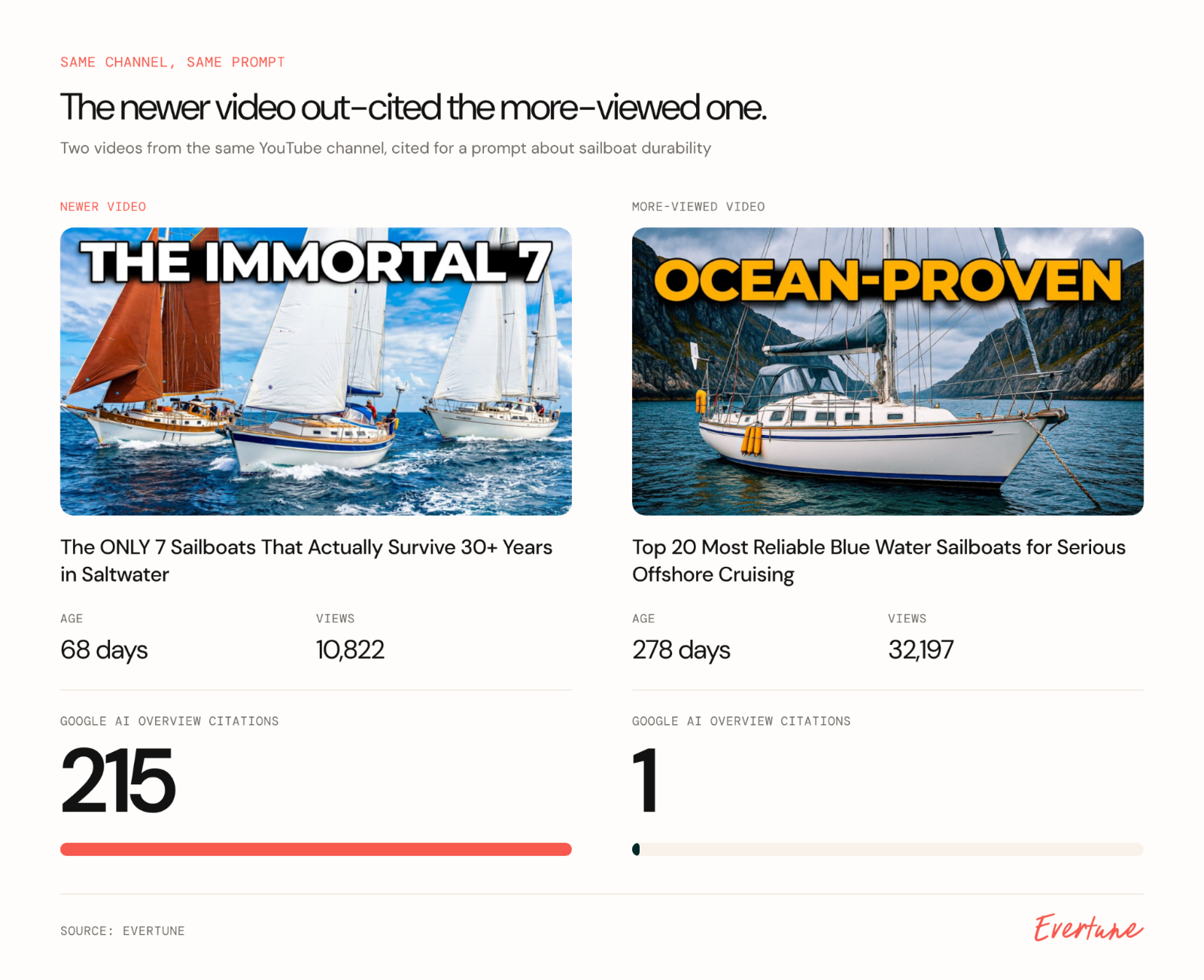
This is an example when the model had a clear choice: the more viewed video or the more recent. It cited the newer video 215 times and the older, more viewed video only once.
This suggests no video trait matters as much to these two Google LLMs as video recency. The more recent the video, the more often the video is cited.
How recent does a video need to be? There is no single number. The median video age varied significantly by topic from 46 days for “high-yield savings accounts” to more than three years for “cough suppressants and expectorants.”
To stand out in any given topic requires being more recent than the other videos relevant to that topic. A topic like savings accounts, where there are many posts about rate changes and expected rate changes, naturally requires publishing more frequently than topics with slower content cadences.
Relevance
How closely a video’s title and description matched the topic and wording of prompts was associated with higher citation rankings on every model, although it did not produce as big a correlation on any model as video recency did on the Google LLMs.
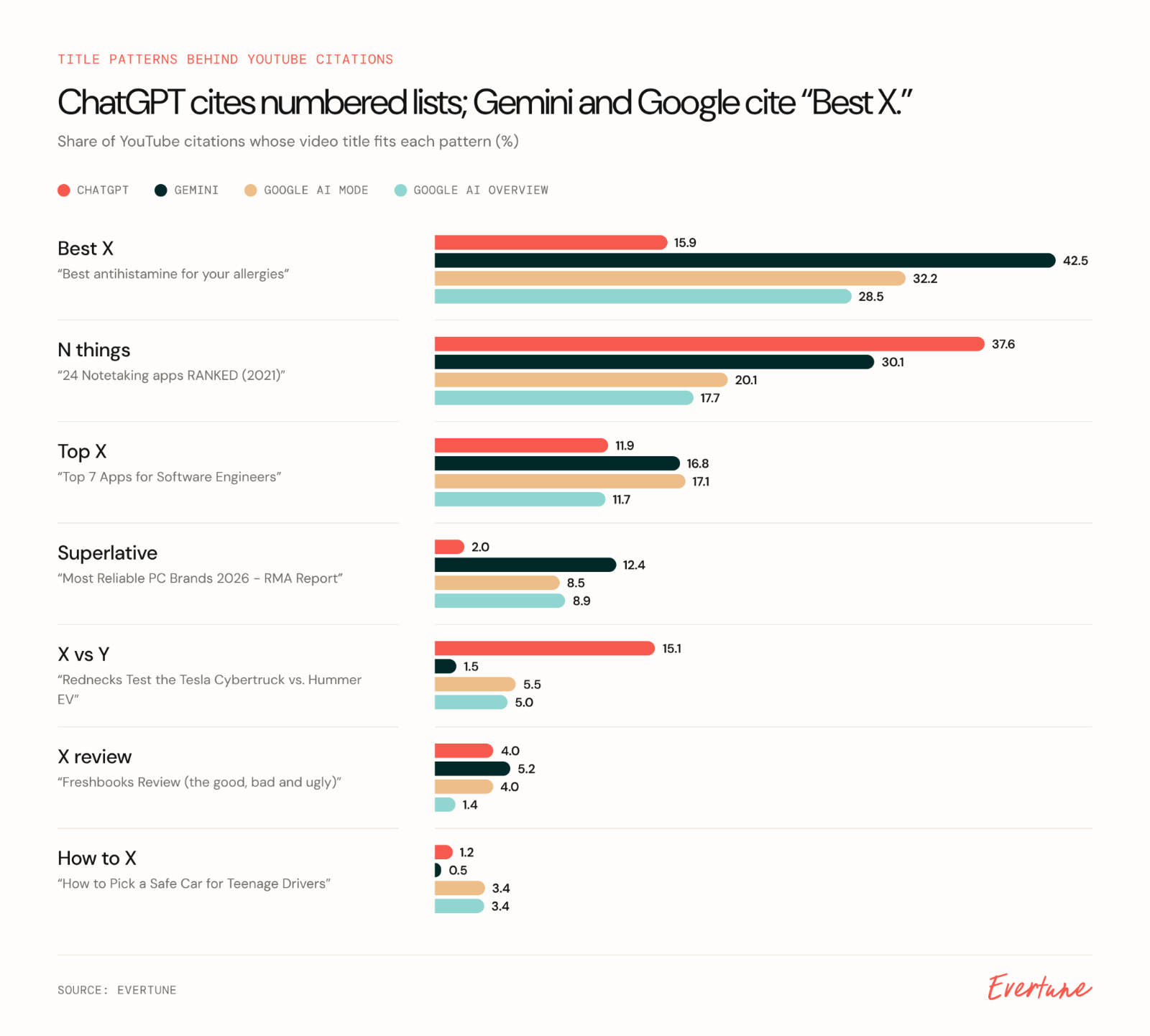
Video titles matched prompt topics via an array of syntaxes, but many were some form of listicle-type title. Each of these title formats makes the topic of the prompt citing it abundantly clear.
Publish often, on topic, across many channels
- Focus on Google’s models and YouTube. Marketers trying to boost AI visibility with social media should expect improvement to be concentrated on Google AI Mode and Google AI Overview, the two LLMs that cite social media the most. These models cite YouTube most frequently, and increasingly so, so that is the domain most worth marketers’ time and attention.
- Name the topic and keep publishing. The best cross-model strategy is to explicitly name the topic in the video title and to include prompt-like words in the video description. However, nothing matters more to Google’s LLMs than video recency. The best strategy for those models is to keep publishing and stay ahead of a topic’s content cadence.
- Spread budget across many influencers. Videos’ popularity — likes, comments, channel subscribers, etc. — did not correlate with high citations, so paying top dollar for the biggest influencers is not the way to boost AI visibility. Rather spreading a budget across multiple influencers, each of whom publishes frequently and on topic, is a wiser strategy.
About Evertune
Evertune is the first Generative Engine Optimization (GEO) platform built to explore, measure, act and advertise across the entire AI customer journey, connecting brands directly to ChatGPT Ads and programmatic advertising partners like The Trade Desk and Index Exchange.
Where most GEO tools sample each prompt once a day, Evertune samples every prompt up to 100 times per model across 11+ AI models, delivering statistically significant visibility data at half the cost of competing platforms.
Evertune’s agents do the work for you: a prompt agent mines over 150 million real user conversations to find the exact questions buyers ask, an insights agent tells you what to do next each week, and an ads agent builds a complete ChatGPT campaign around your visibility gaps. From there, Evertune closes the loop with website optimization, data-driven content creation, source-level influence mapping and paid activation through affiliate and programmatic AI retargeting partners. Founded by the team that pioneered programmatic advertising at The Trade Desk, now building the next marketing channel.