
AI is getting personal. As you chat with ChatGPT, it takes notes about your preferences, interests, and needs, then uses what it learns to shape future answers. These notes are called memories.
Some memories are demographic: where you live, how old you are, your family, the job you do. Others are about your interests: where you like to travel, what you do on weekends and, increasingly, what you like to buy.
To see what those memories actually contain, Evertune partnered with consumer data company Gener8. Its panelists shared more than 2,200 ChatGPT memory records with us across the US and UK. After removing empty ones ("ChatGPT doesn't know much about you yet"), we analyzed 1,657 real memories, alongside about 2,700 real prompts that panelists sent ChatGPT. We looked for the patterns that repeat across memories, how often ChatGPT uses them and how much they change the answers people get.
72% of memories mention a brand
The first thing that jumped out was how often brands appear. 72% of ChatGPT memories mention at least one brand (1,190 of 1,657). That's brands in the broadest sense: the phone someone uses, the software they work in, the football club they support, the shows they watch. Most memories name a handful: 90% mention 10 or fewer.
The top of the list holds few surprises. Apple leads by a wide margin, appearing in 258 memories, followed by the usual suspects: Microsoft, Amazon, Instagram, Google, TikTok, Facebook, YouTube and WhatsApp.
The long tail is more revealing. Memories record the marketplaces people sell on (Etsy, Vinted, Shopify), the apps they bank and invest with (Monzo, Trading 212), the software they use at work (HubSpot, Xero), the weight-loss drugs they take (Mounjaro, Wegovy) and the energy supplier they chose (Octopus Energy).
47% of memories hold buying signals
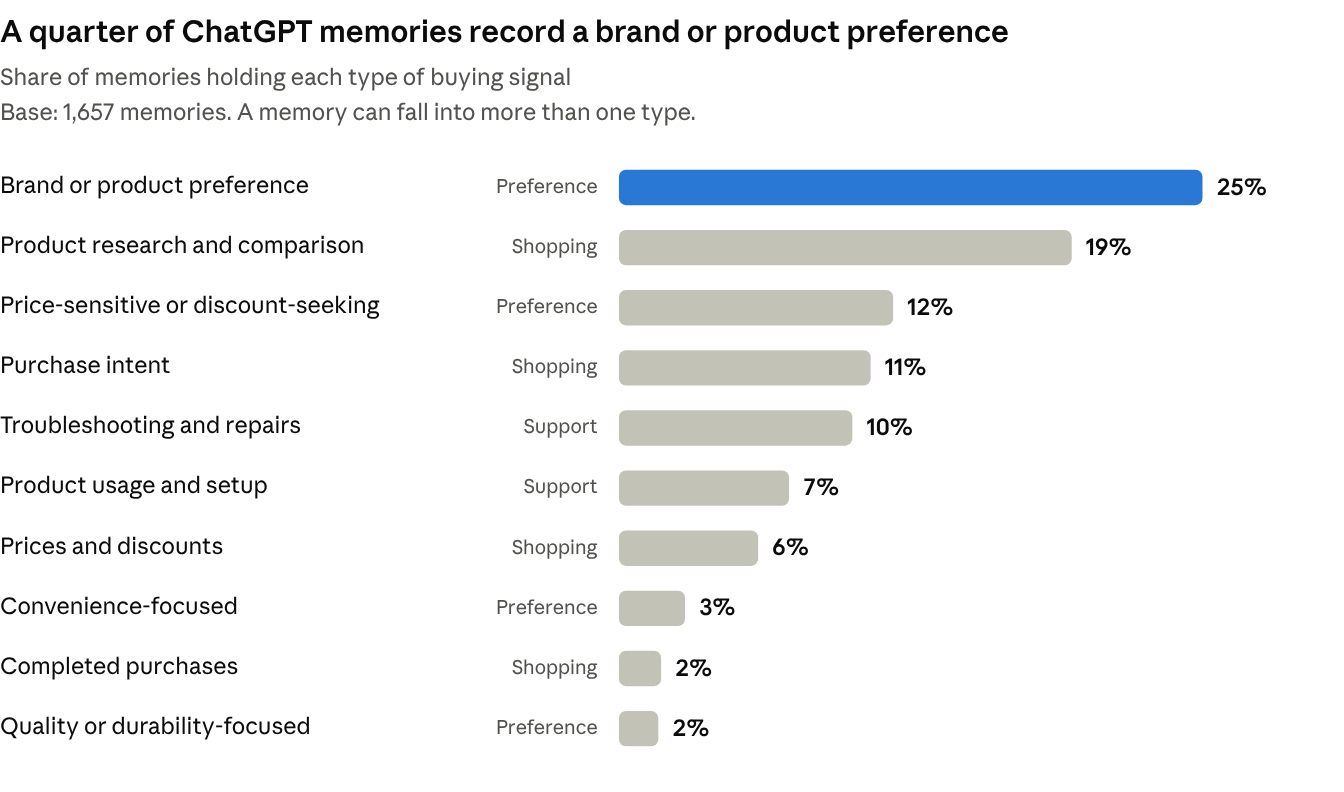
Not every brand mention is about buying. A memory that says you support Arsenal or drive for Amazon names a brand without saying anything about what you'll buy next. So we also looked for buying signals: what people are researching, what they plan to buy, which brands and products they prefer, how price-sensitive they are and what they need help fixing. 47% of memories contain at least one buying signal, with or without a brand name attached.
September-October 2026
Brand and product preferences are the single biggest type, at a quarter of all memories. Shopping activity (research, purchase intent, deals and completed purchases) and product support follow close behind.
A memory reads like a brief on the buyer
The detail is striking. Here are some snippets of buying focused memories:
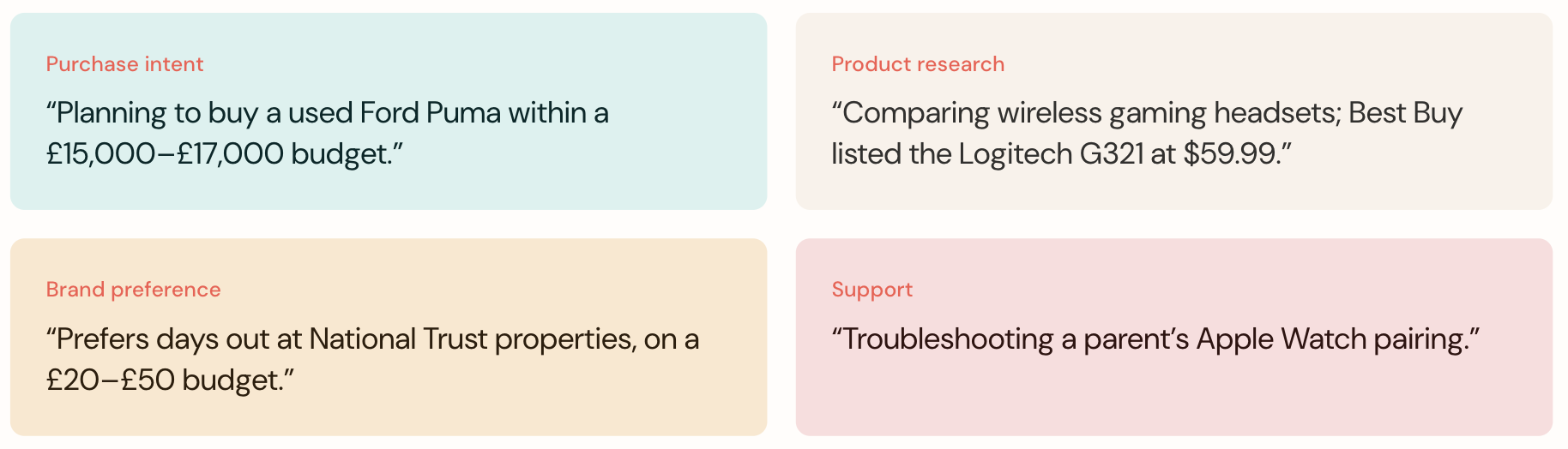
That's the brand, the model, the budget and the retailer. A media planner would pay a lot for a brief this specific. ChatGPT builds one for every user.
Only 24% of answers use memory today
Next, we looked at how often ChatGPT actually uses those memories. 24% of responses drew on a detail from the user's stored memory. That's roughly one answer in four, and it's lower than we expected.
It won't stay there. Memory and personalization have been among the hardest problems in AI to solve, and the AI companies are investing heavily in getting them right. We're at the very start of a shift toward everyone having their own personalized LLM. Expect that 24% to climb fast.
Asking for a recommendation triggers memory most
Next, we looked at which prompts are most likely to pull memory into the answer. The wording people use makes a big difference.
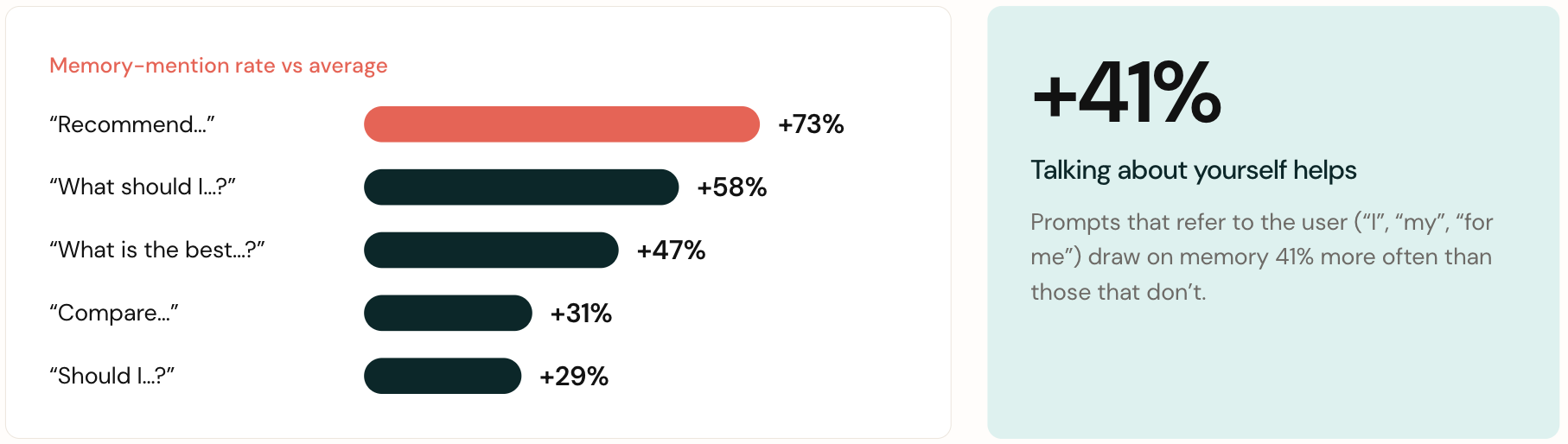
When someone asks ChatGPT to recommend something, it draws on their memory 73% more often than average. Talking about yourself has a similar effect: prompts that refer to the user ("I", "my", "for me") draw on memory 41% more often than those that don't.
Put simply, memory shows up at the exact moment a buyer is choosing a brand.
How much does memory change the answer?
Knowing that memory gets mentioned is one thing. We wanted to know how much it actually changes the answer a person sees.
So we took real prompts from the panel and ran each one 100 times through Evertune's Prompt Engine to simulate what an average user would get without memory. Then we scored how far the memory-informed answers moved away from the generic ones. A score of 100 means memory substantially changed every answer; 0 means it made no difference.
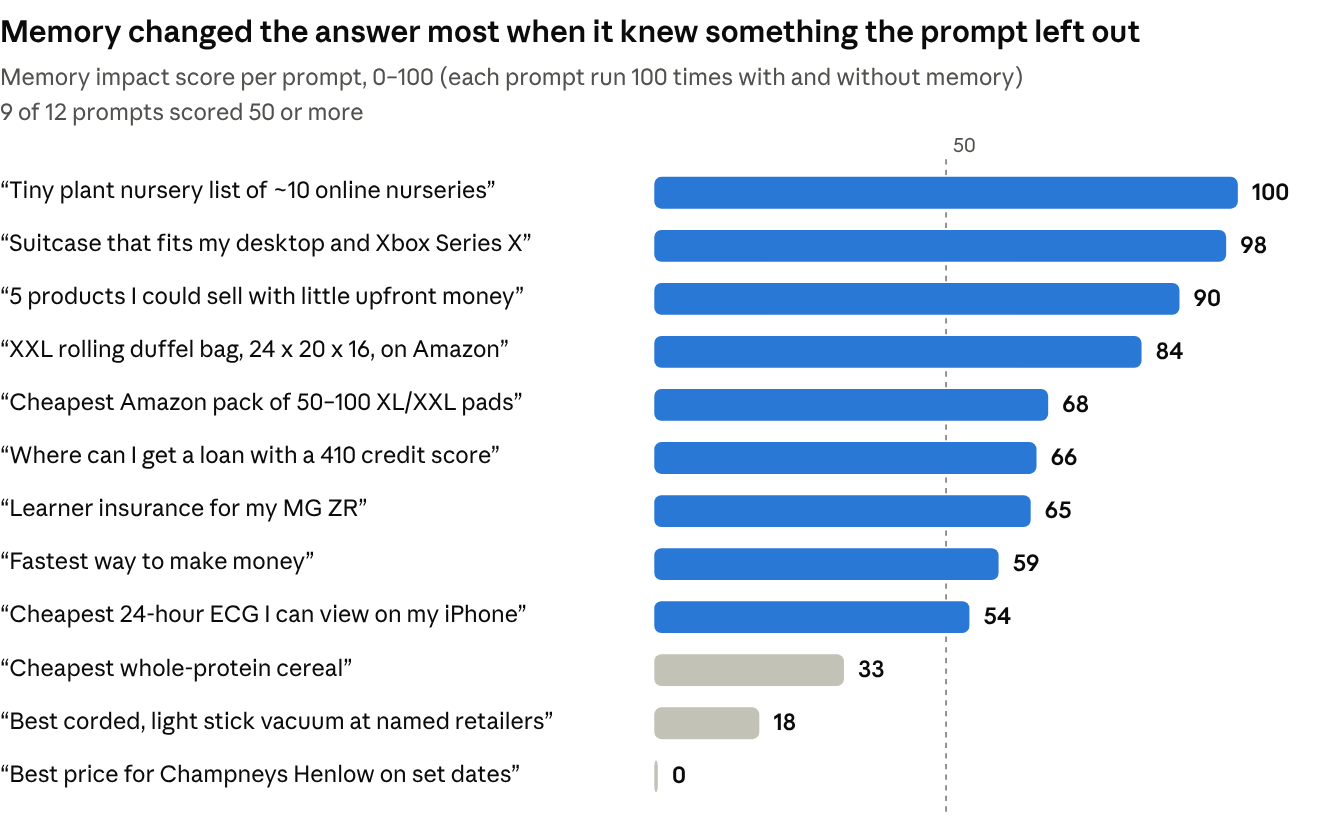
Memory seems to have the most impact when it knows something the prompt leaves out. "Give me a suitcase that can carry both my desktop and Xbox Series X" scored 98 because ChatGPT already knew which PC case the user owned. Without memory, it asked for the dimensions. With memory, it named a specific case that fits. The learner insurance prompt scored 65 because memory knew the car was a 2004 model with planned modifications, which reshuffled which insurers came first.
The prompts that barely moved were the ones fully pinned to an outside fact, like the best price for a two-night stay at Champneys Henlow on set dates. There's no gap for memory to fill.
That's the moment that matters for brands. Buyers rarely spell out every preference when they ask for a recommendation. Whatever they leave unsaid, memory now fills in.
What this means for marketers
AI is going to get more personal. That much is clear. But what does it mean for you as a marketer?
Start with the caveat: memory isn't used every time yet. Today it shapes about one answer in four. That will change quickly, to the point where everyone's AI knows them well. Once that happens, everyone effectively has their own unique LLM. That has two big consequences.
1. Getting into memory becomes a campaign goal
Until now, the question for AI visibility has been: does AI mention my brand? That's still the right question. But there's a second one now: is my brand part of the user's story, so it ends up in their AI memory?
A brand stored in someone's memory gets a head start every time that person asks "what should I buy?" or "what do you recommend?" A brand that isn't there starts from zero.
The practical shift is to give customers reasons to declare their preferences to their AI. Some ways that could look:
- A call to action that talks to the AI. A TV or social ad that ends with "Tell ChatGPT we're your go-to for running gear" instead of "Visit our website."
- Loyalty that rewards remembering. A hotel group offers bonus points to members who tell their AI assistant it's their preferred place to stay.
- Post-purchase prompts. A confirmation email suggests: "Ask ChatGPT to remember you own the Model X so it can help with setup and accessories."
- Preference moments in the product. A skincare brand's quiz ends by suggesting customers tell their AI their skin type and the products that work for them.
None of these are standard practice yet. The brands that test them first will learn fastest.
2. Measuring AI visibility becomes more like measuring people
The second consequence is about measurement. If everyone has their own LLM, there is no single "AI answer" to track.
Prompts were already scattered. As we showed in our analysis of the AI search demand curve, search demand has a pointy head of popular keywords and a long tail. AI demand is almost all tail: over 80% of AI prompts are unique, compared with 15% of search queries, and the median prompt runs 19 words. Memory makes it more unique still, because now the same prompt gets a different answer for each person asking it.
In traditional SEO, the job was to find the most popular keywords and track them. That isn't possible in AI. There's no short list of prompts that everyone asks, and no single answer everyone sees.
So measure AI the way you measure people. You can't ask every customer what they think of your brand. Instead, researchers design a survey: a set of questions and a sample of respondents built to represent the market. Most of the effort goes into that design, because the answers are only as good as the sample.
AI visibility now needs the same discipline:
- Track prompt patterns, not exact wording. Care about the themes and the ways people ask ("recommend…", "what should I…", "compare…"), but don't obsess over any one prompt's phrasing. Build your prompt bank from what real buyers actually ask.
- Build personas into your measurement. Memory is, at heart, a persona: where someone lives, what they earn, what they own, what they care about. A price-sensitive parent in Manchester and a premium-focused professional in New York will get different answers to the same prompt. Define the handful of personas that make up your market (say, the bargain hunter, the brand loyalist and the first-time buyer) and test how AI answers change for each.
- Sample at scale. AI is probabilistic, so one answer tells you nothing. Evertune runs each prompt 100 times per model to separate signal from noise.
The brands that win in AI search will treat it like understanding a population of people, not ranking on a page of results.
About the research
Evertune and Gener8 analyzed 1,657 ChatGPT memories shared by Gener8 panelists in the US and UK, along with about 2,700 of their real ChatGPT prompts, in September and October 2026. Memories were classified by AI for brand mentions and buying signals. The memory impact test ran 12 real panel prompts 100 times each, with and without the panelist's memory. Findings on how memory shapes answers come from a smaller sample and should be read as directional.