
ChatGPT opened its self-serve advertising platform to all U.S. advertisers on May 5, 2026. Instead of keywords, ChatGPT asks advertisers to write "context hints" which are free-form descriptions of the conversations where their ads should appear. The interface is a blank text box, which means most marketers' first move is to type in their existing keyword list. But AI search works differently than traditional search, and so context hints should be semantic descriptions of the conversations you want to show up in. This type of targeting is unique to AI advertising and understanding how to appropriately set targeting in ChatGPT is critical to making this new channel work for your brand.
What is a context hint?
A context hint is a 1-to-2-sentence plain-language description of the buyer moment you want your ad to appear inside. It tells ChatGPT's matching system the type of conversation where your brand is relevant. Who the user is, what they're trying to accomplish, and what surrounding context qualifies the placement.
The matching doesn't work on literal text overlap. It works on semantic embeddings, meaning ChatGPT reads the meaning of your hint and the meaning of a live user conversation, then decides whether they're close enough to serve the ad. The same hint can match thousands of different phrasings of the same intent.
A keyword tells Google which words to look for. A context hint tells ChatGPT which type of person, in which type of conversation, you want to reach.
How Evertune's Visibility Boost builds context hints from your data
Writing effective context hints requires knowing two things: which conversations users are having related to your category, where your brand is and isn't showing up in them.
Evertune's Visibility Boost solves this by generating context hints directly from your organic AI visibility data. Rather than asking marketing teams to translate keywords into buyer descriptions from scratch, Evertune's AI agent pulls your tracker data and scores your consumer preferences and topics by AI Brand Score (how often your brand appears in AI responses, weighted by position).
That score determines the campaign structure automatically:
- Low visibility topics (Boost): Conversations where competitors are showing up and you're not. Every paid impression buys ground you don't currently own.
- Medium visibility topics (Grow): Conversations where you appear inconsistently. Paid amplification turns unreliable presence into consistent presence.
- High visibility topics (Reinforce): Conversations where you're already converting. Defensive campaigns protect positions you've earned.
The context hints themselves are written from your tracker insights, phrased as user intents, not keywords, and shaped around the actual conversations happening in ChatGPT where your brand needs to appear. Ad copy is generated to address the specific visibility gap each campaign targets, and Evertune crawls your domain to match each topic to the most relevant landing page.
The result is a fully structured campaign, ready to launch, derived entirely from data you already have in the platform.
What this means for the AI customer journey
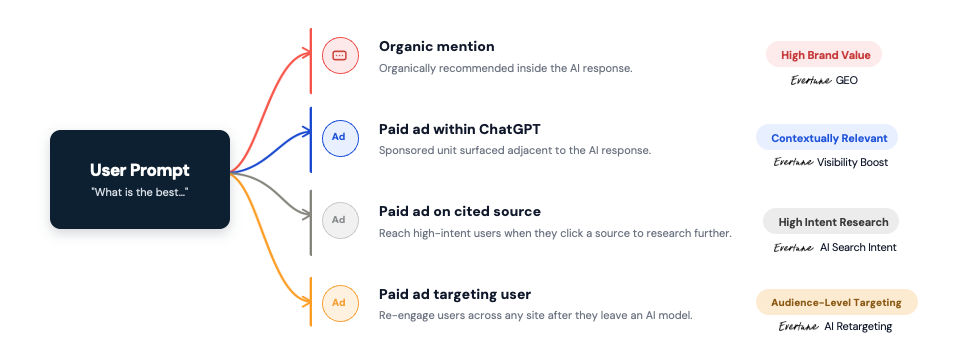
Every brand’s #1 goal is to earn organic mentions within an AI response. That's what Evertune's core GEO products are built to achieve. Organic recommendations carry the highest brand value because they come with the implicit endorsement of the model. But GEO takes time and if your brand isn’t being recommended, you need to get in front of buyers now.
That’s where paid ads adjacent to that organic response are valuable. For topics where organic presence isn't established yet, paid placement buys visibility while GEO builds it through Visibility Boost.
When users click through to a cited source to research further, Evertune's AI Search Intent product puts your brand in front of them at a high-intent research moment. And if they leave without converting, AI Retargeting re-engages them across any site they visit next.
No other platform covers all four entry points from a single source of brand intelligence.
Questions to ask before launching ChatGPT ads
- Are my context hints written as buyer descriptions, not keywords?
- Does each ad group have a single, focused hint, or am I diluting precision across multiple intents?
- Do I know which topics in my category have low organic AI visibility? Am I prioritizing those in my campaign structure?
- Is my targeting built on actual AI response data, or on assumptions about what conversations are happening?
Ready to learn more about how Evertune connects organic AI visibility data to your ChatGPT advertising strategy? Book a demo to see Visibility Boost in action.
Evertune is the marketing platform for brand discovery in AI search. We help brands reach buyers whose customer journey now includes AI, tracking real search behavior and prompt volumes across 150M prompts, improving organic visibility through GEO, creating data-driven content built for AI education and advertising to buyers in and beyond the AI conversation. As AI agents increasingly drive purchase decisions, the brands with visibility infrastructure in place today will own the category tomorrow.
Founded by the Trade Desk founding team, trusted by marketing and data analytics leaders across every major vertical, and backed by $20M in funding, our data is used by AI model makers themselves. To see where your brand stands in AI search today, visit evertune.ai.