
OpenAI has shaken up the shopping experience on ChatGPT, introducing tables and other visuals to make more direct product comparisons. The large-language model (LLM) now often picks overall winners by value and price and evaluates products head-to-head on several product-specific attributes.
“You can now browse products visually, compare options side-by-side, and get detailed, up-to-date information - all in one place,” the company announced on March 24.
One of the biggest changes is the introduction of a “comparison table.” The layout, which replaces the previous widget that usually showed three or four product images with price and star-ratings, goes far deeper in making product comparisons (there is a full before-and-after view in the company’s announcement). The changes rolled out on ChatGPT free, Go, Plus, and Pro users last week.
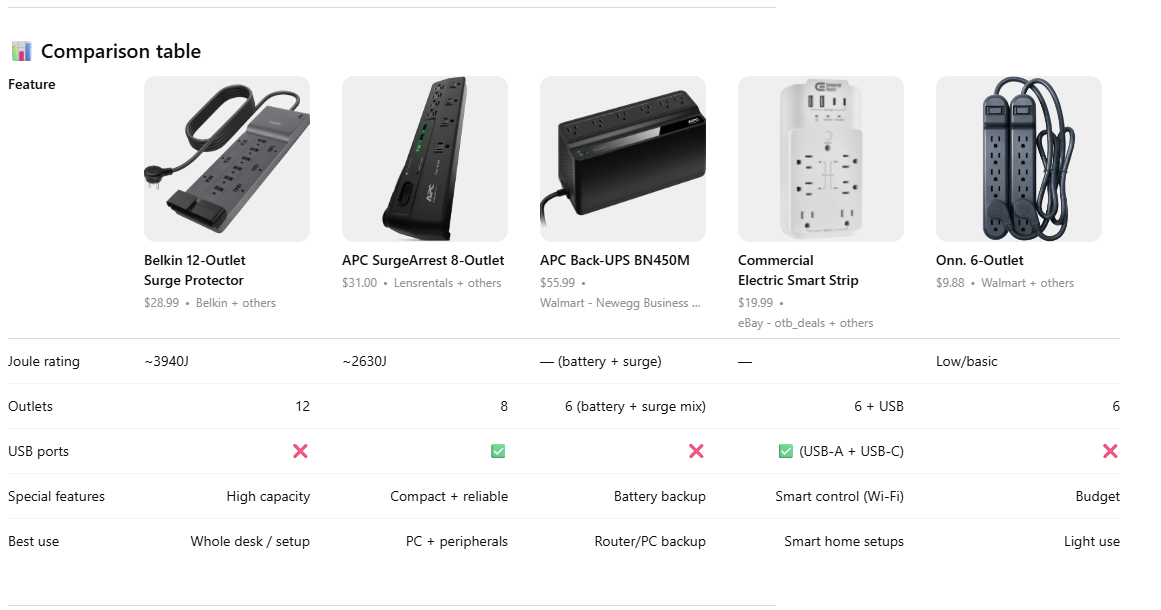
The tables rate the products against each other the way review and affiliate sites often do, aiming to keep the would-be shopper inside of the chat instead of them clicking out for “hours of searching and tab-hopping,” OpenAI noted.
“For users, this turns shopping from a fragmented, time-consuming process into a single, seamless experience,” the release said. “For merchants, it brings higher-intent shoppers who are closer to making a decision.”
ChatGPT loves to compare on price
We have already seen this new shopping experience proliferate on the Evertune platform. Out of 21,000 responses to shopping-like prompts made on March 26, almost 6,400 (nearly 1 in 3 responses) had a table layout like the screenshot above. The table layout was present in each of the 11 product categories we queried.
The vast majority - 88% - of the responses with tables included a “Best for” or “Best use” row that highlighted a product-specific superlative. Power strips highlight “smart home setups” or “outdoor use,” purses emphasize “formal settings” or “a night out,” and so on.
ChatGPT generated more than 7,500 unique superlatives in the “Best for”/”Best use” rows of these tables responding to our prompts. By far the most frequently used superlatives across all our product categories were some form of “Budget” or “Cheapest option,” which declared the best project simply by price, and some form of “Overall value” or “All-around use,” which declared ChatGPT’s top pick for the given prompt.
About 43% of the “Best for” categories included the words “Budget” or “Cheap”, and about 19% included the words “Overall” or “All-around” - combining for 62% of all the “Best for” categories.
Top 10 Shopping "Best for" Categories

Product comparisons get very specific
Excluding the categories that include the words “budget,” “cheap,” “overall” and “all-around,” the most-used “Best for” categories were more domain-specific based on the type of product being shown in the responses.
Most Common "Best For" Labels by Category
Top 5 superlatives from ChatGPT shopping comparison tables, excluding budget & overall-value labels
In addition to these “Best for” superlatives, the product comparison tables break out other points of comparison specific to the type of product being shown. While almost all tables have some form of price range comparison, the rest of the table rows are highly specific to the products.
For example, when responding to one of our prompts about Wi-Fi routers, ChatGPT compared “Wi-Fi standard,” “Speed class” and “Ease of setup.” In a response about headphones, it compared “Noise cancellation,” “Sound quality” and “Battery life.” For pet food, it compared “Bag size,” “Ingredient quality” and “Special features.”
LLMs are all in on shopping experiences
Last week’s changes show OpenAI remains heavily invested in the AI shopping experience, even as it pivots away from other endeavors like its Sora AI video-generation app. In addition to adding native product comparisons to its shopping experiences, OpenAI has reportedly removed in-chat checkouts and embedded Walmart’s AI, Sparky, within ChatGPT’s shopping responses - all within the last month.
This increased focus on shopping emphasizes that AI shopping experiences are here to stay. Gemini, too, is focusing heavily on shopping, announcing just last week a new partnership with Gap to sell products from the retailer’s family of brands directly inside of Gemini.
The news is all the more reason for brands to improve their AI visibility and understand the consumer preferences within their product category, the same kind of preferences in which ChatGPT will now likely rate brands’ products against their competitors.
Methodology
At Evertune Research we track hundreds of brands across 250 categories. For this analysis, we reviewed about 21,000 of ChatGPT’s responses to shopper-like prompts across 11 product categories.
Evertune is the AI marketing platform for Generative Engine Optimization (GEO) that helps brands improve visibility in AI search by analyzing responses at scale and delivering actionable insights. Evertune works with leading brands across all verticals, including Finance, Retail and E-Commerce, Automotive, Pharma, Tech, Travel, Food and Beverage, Entertainment, CPG, and B2B. Founded by early team members of The Trade Desk, Evertune has raised $20M in funding from leading adtech and martech investors. Headquartered in New York City, the company has a growing team of more than 40 employees.