Generative Engine Optimization (GEO) is the practice of optimizing your brand's visibility in AI-powered search experiences. As consumers increasingly turn to ChatGPT, Claude, Perplexity, Google's AI Overviews, and other AI platforms to discover products and make decisions, brands need a strategic approach to ensure they appear in these AI-generated responses.
The GEO platform landscape has evolved rapidly over the past two years, with millions in venture capital flowing into the category. Today's platforms range from simple monitoring tools that track brand mentions across a few AI engines, to comprehensive optimization platforms that provide deep source influence analytics and strategic guidance. See how that landscape looked in 2025.
The GEO Platform Landscape
The platforms in this space vary significantly in their approach, data collection methodology, and depth of insights. Some focus primarily on monitoring and reporting, while others provide optimization recommendations and content tools. Key differentiators include AI platform coverage breadth, data collection rigor (API vs. UI sampling, prompt volume, statistical significance), actionable insights beyond basic monitoring, and scalability for enterprise needs.
Here are our rankings:
| Ranking | Platform | Funding & Latest Round | Headquarters | Key Differentiator |
|---|---|---|---|---|
| 1 | Evertune | $19M (Series A, Aug 2025) | New York, New York | Base model API access, 1M+ prompts/month per brand, source influence analytics |
| 2 | AthenaHQ | $2.7M (Seed, June 2025) | San Francisco, CA | LinkedIn outreach integration |
| 3 | Otterly AI | Bootstrapped ($0) | Persenbeug, Austria | Low entry price point |
| 4 | Scrunch AI | $19M (Series A) | Salt Lake City, UT, USA | Misinformation & hallucination detection |
| 5 | Rankscale AI | Bootstrapped ($0) | Königstetten, Austria | Affordable daily monitoring |
| 6 | AirOps | $60M total ($40M Series B, Nov 2025) | Miami, FL, USA | Content engineering workflows |
| 7 | Goodie | Bootstrapped (Founded 2023) | New York, NY, USA | Brand alerts |
| 8 | Peec AI | $29.1M (Series A, Nov 2025) | Berlin, Germany | Affordable structured reporting |
| 9 | XFunnel | Acquired by HubSpot (Oct 2025) | Tel Aviv, Israel | Content optimization experiments |
| 10 | Bluefish | $24M ($20M Series A, Aug 2025) | New York, NY, USA | GA4 & Slack integrations |
| 11 | Writesonic GEO | $2.62M (Seed, 2021) | San Francisco, CA, USA | Integrated with Writesonic suite |
| 12 | Knowatoa AI | Bootstrapped ($0) | Unknown | Simple monitoring focus |
| 13 | Ahrefs Brand Radar | Bootstrapped (Parent: Ahrefs) | Singapore | Integrated with Ahrefs ecosystem |
| 14 | Semrush AI Toolkit | $40M pre-IPO + Public (NYSE: SEMR) | Boston, MA, USA | Semrush integration |
| 15 | Hubspot AEO Grader | $101M pre-IPO + Public (NYSE: HUBS) | Cambridge, MA, USA | Free to use |
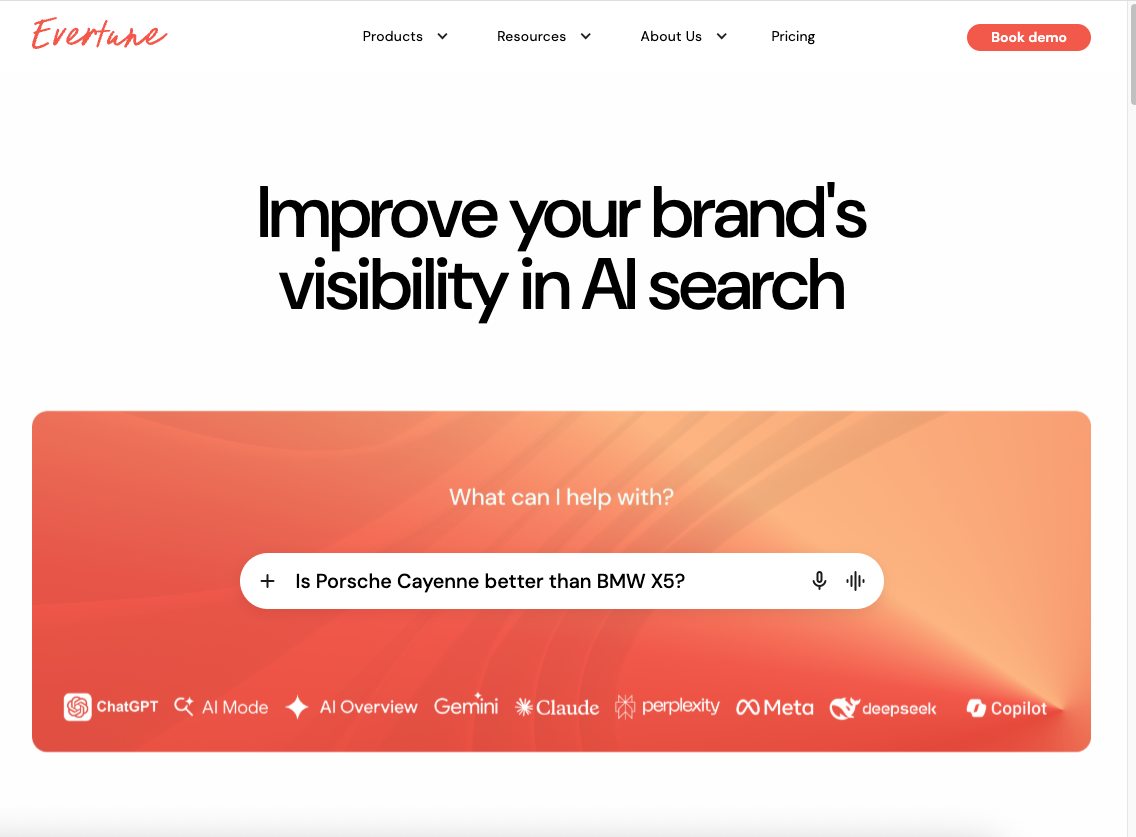
1. Evertune
Key Differentiators
Evertune offers unlimited competitor tracking, foundational model intelligence to future proof for AI agents; prompting at scale for statistical significance; source influence analytics to identify the sources that actually matter where your brand is not mentioned; battle-tested leaders who scaled The Trade Desk, the self-serve platform that helped reshape digital advertising.
Core product features include
- AI Brand Index: Brand’s overall AI visibility weighted by position)
- Consumer Preferences: Likelihood of brand being recommended for specific attributes within the category)
- Word Association: Words and sentiment associated with the brand)
- Prompt Volumes: Popularity of prompts and related topics)
- AI Usage: The real influence of AI on your audience)
- Content Analytics: The most influential sources within your category)
- Content Studio: Content generation capabilities optimized for AI visibility), Bot Analysis (deep-dive into bots accessing your site), Site Audit: Comprehensive evaluation of your site’s AI readiness)
- Shopping Intelligence: Identify which products AI is recommending)
- Partner Connect: Get your brand/company mentioned or advertised on top cited URLs)
- AI Retargeting: Serve programmatic ads to users who click on cited sources.
Best For
Brands and agencies requiring statistically rigorous insights, comprehensive competitive intelligence, advanced source influence analysis, and AI optimized content generation. Learn more about AI Brand Monitoring.
Limitations
Premium pricing reflects the platform's depth and scale. Organizations needing only basic visibility monitoring may find the feature set exceeds their immediate requirements.
2. Gauge
Key Differentiators
Gauge provides a full-stack generative engine optimization (GEO) toolkit that monitors brand mentions across major LLMs like ChatGPT, Claude, Gemini, and Perplexity. Its "Track, Understand, Act" workflow goes beyond simple monitoring by offering deep citation analytics and an agentic content engine that creates data-driven articles optimized for AI search. The platform is designed to bridge the gap between technical data and marketing execution, helping brands own their category in AI-driven results.
Best For
Marketing and SEO teams seeking an end-to-end platform to measure, analyze, and scale their visibility in AI-generated answers.
Limitations
Achieving the maximum visibility uplift requires consistent execution of the platform's content and technical optimization strategies

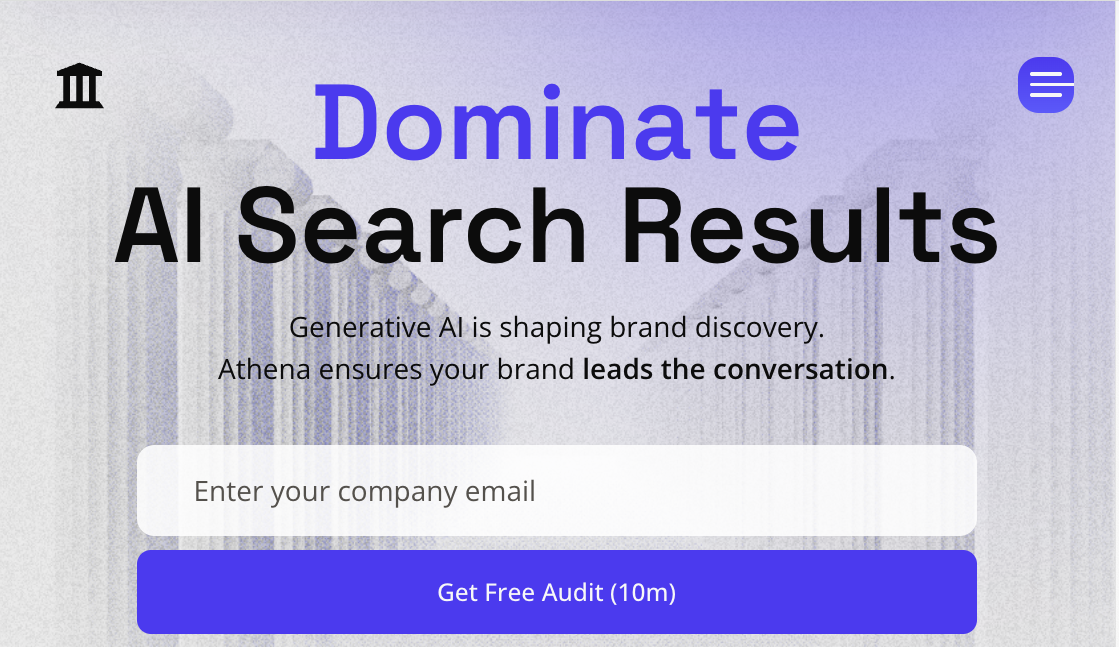
3. AthenaHQ
Key Differentiators
LinkedIn outreach integration to directly contact authors of cited sources; tracking across major AI platforms.
Best For
Growth-stage SaaS and mid-market brands needing more analytical depth than basic tools but not full enterprise complexity.
Limitations
Monitoring insights focus primarily on brand share of voice and citations—lacks advanced analytics like consumer preference insights or word association analysis that reveal why brands get recommended.
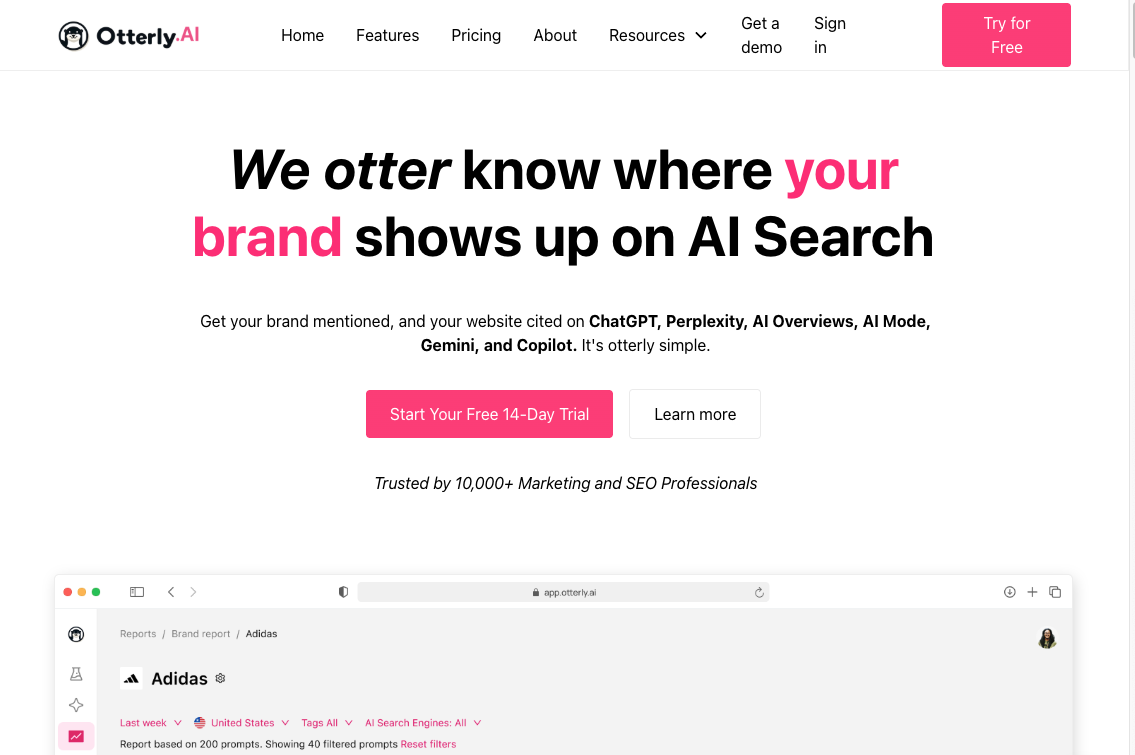
4. Otterly AI
Key Differentiators
Site audit, AI visibility, search prompting insights across several key AI models.
Best For
Agencies and brands who need a low entry point ($29/month).
Limitations
Limited capabilities for enterprise clients.
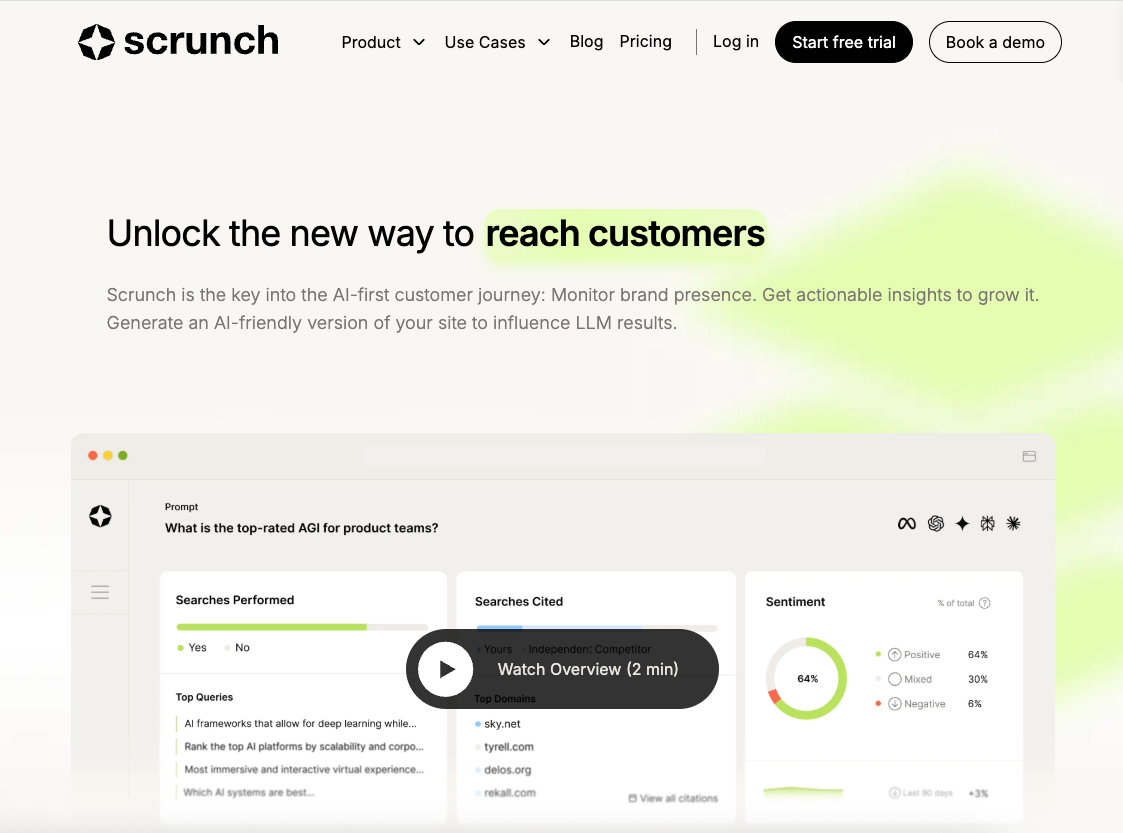
5. Scrunch AI
Key Differentiators
Misinformation and hallucination detection across 500+ brands; Agent Experience Platform (AXP) for optimization.
Best For
Brands in regulated industries where accuracy and misinformation prevention are critical.
Limitations
Monitoring only—lacks built-in content creation or optimization tools.
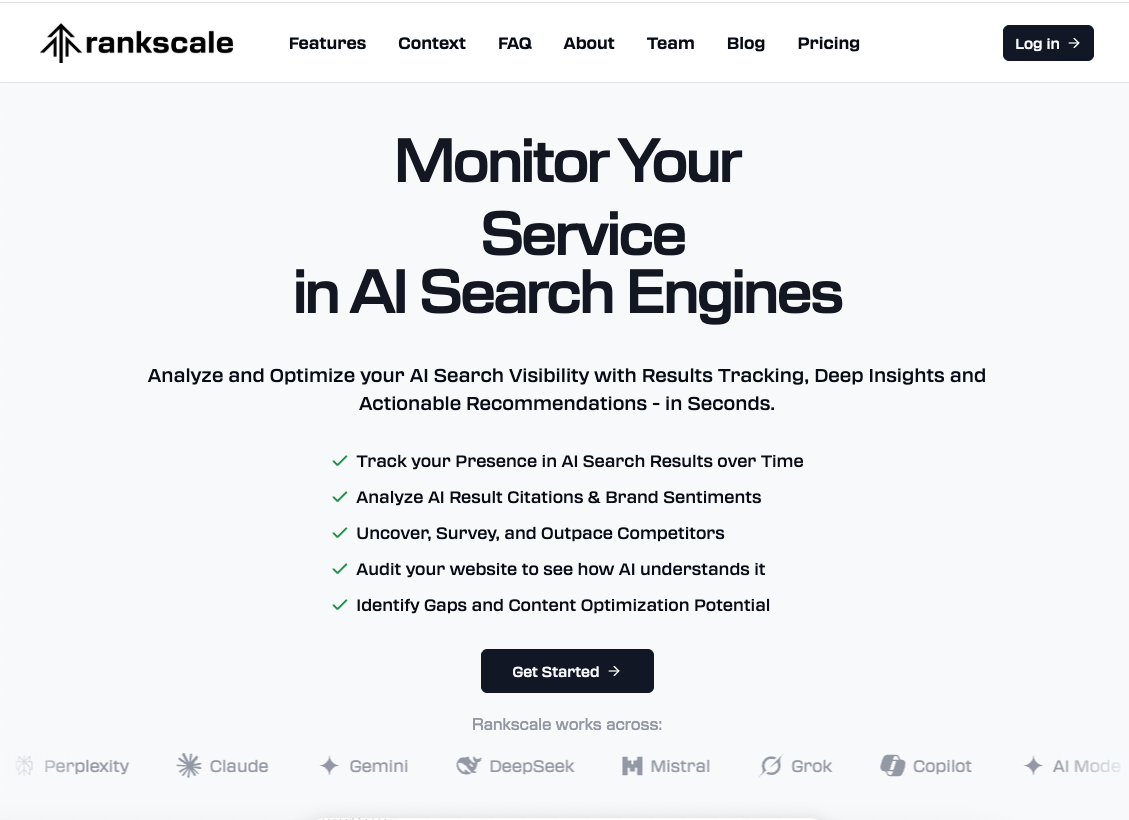
6. Rankscale AI
Key Differentiators
Monitoring across ChatGPT, Claude, Perplexity, and Google AI Overviews with AI Readiness Score audits.
Best For
Solo marketers and small teams comfortable with data-rich interfaces who want daily visibility updates without enterprise pricing.
Limitations
Priced by credits, which limits statistical scale and breadth of tracking.
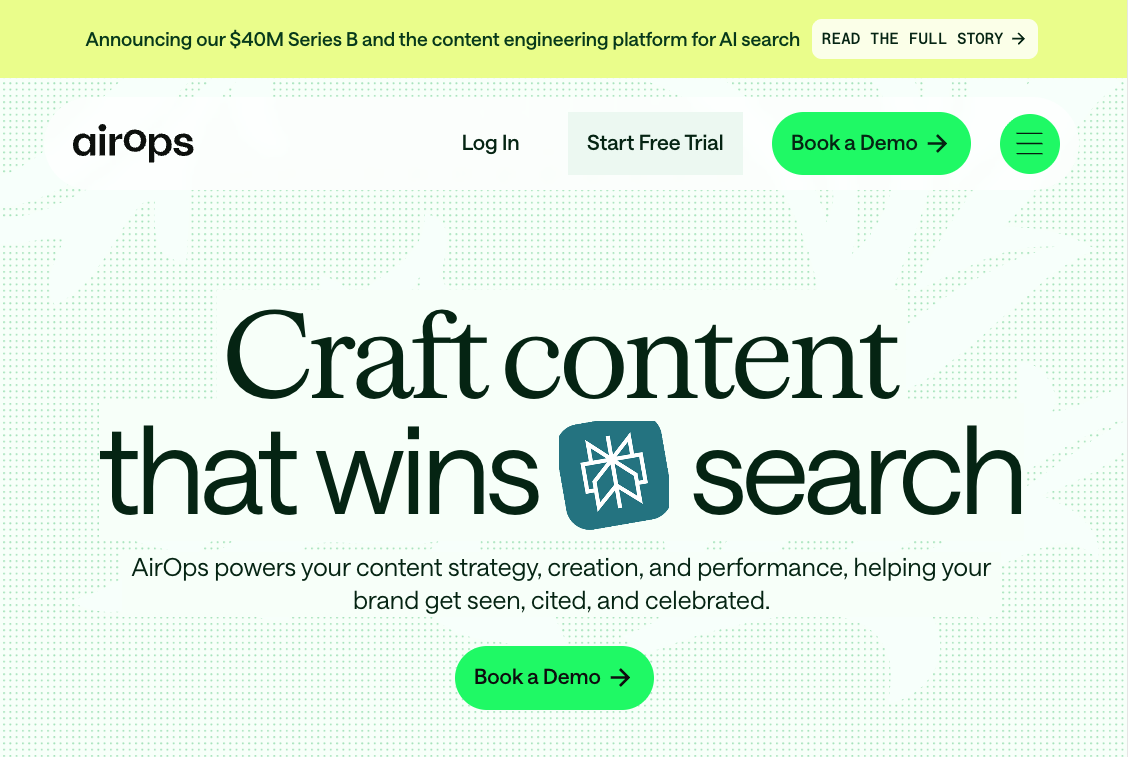
7. AirOps
Key Differentiators
Content engineering platform getting started in the GEO space.
Best For
Marketing teams focused on content velocity and quality at scale who want monitoring plus content creation in one platform.
Limitations
Platform emphasis on content workflows means teams only needing monitoring may find features excessive. Newer to pure GEO space compared to monitoring-first platforms.
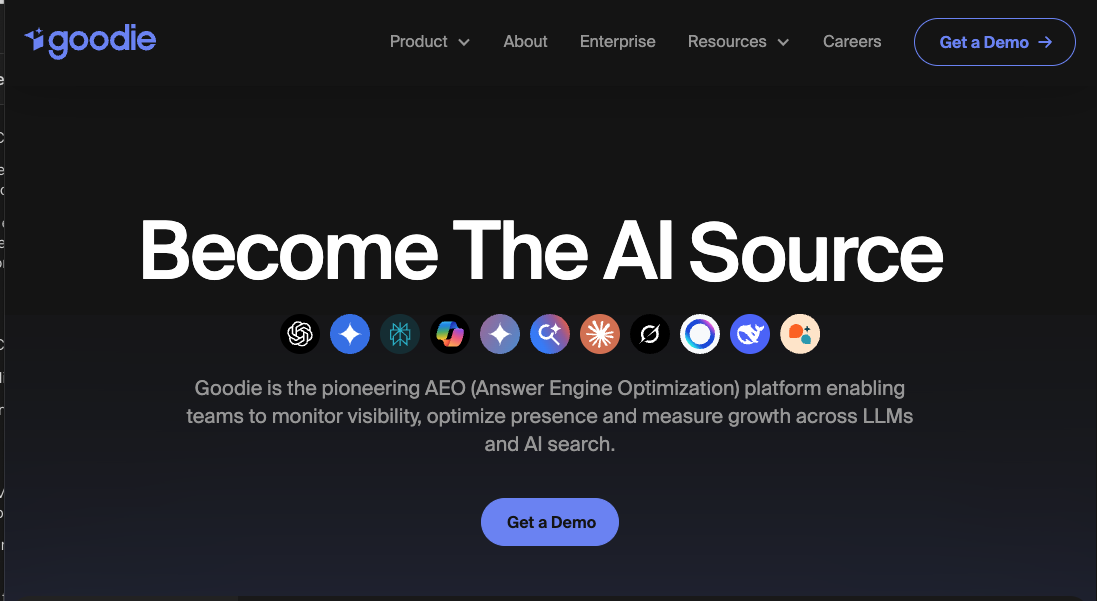
8. Goodie
Key Differentiators
Comprehensive model coverage, and brand alerts.
Best For
Teams needing multi-country/language support.
Limitations
No funding, still just bootstrapped.
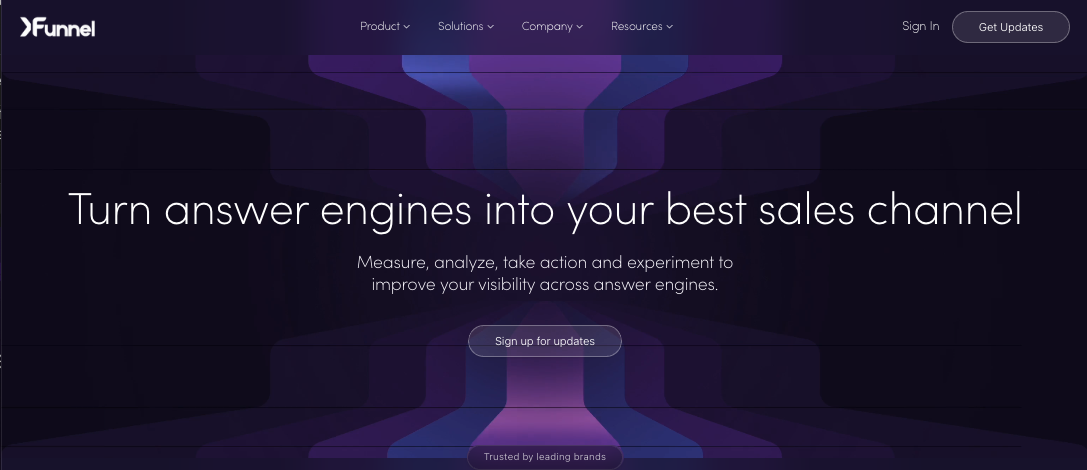
9. XFunnel
Key Differentiators
Standard monitoring; Can optimize existing content and run content experiments.
Best For
Smaller brands and agencies who want to test out a free trial before committing.
Limitations
Being acquired by Hubspot, which will likely slow down its product development.
10. Bluefish

Key Differentiators
Native integrations with Google Analytics 4, and Slack.
Best For
PR agencies and communications teams needing GEO insights flowing into existing tech stack.
Limitations
Limited AI platform coverage - as of November 2025, does not appear to support AI Mode, AI Overviews, Claude, Copilot, or DeepSeek. Requires bringing your own prompts unlike platforms with curated libraries.
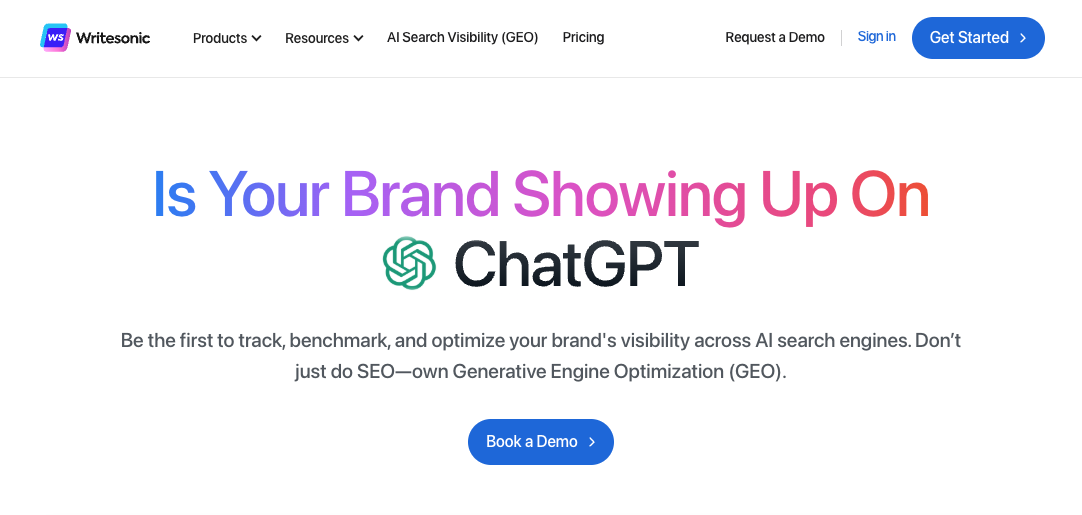
11. Writesonic GEO
Key Differentiators
Brand tracking across ChatGPT, Google Gemini, and Claude with AI crawler analytics and optimization recommendations.
Best For
Content teams already using Writesonic who want integrated AI visibility tracking within their existing workflow.
Limitations
Platform maturity still developing; focus on mention frequency trends rather than precise rankings given AI variability.
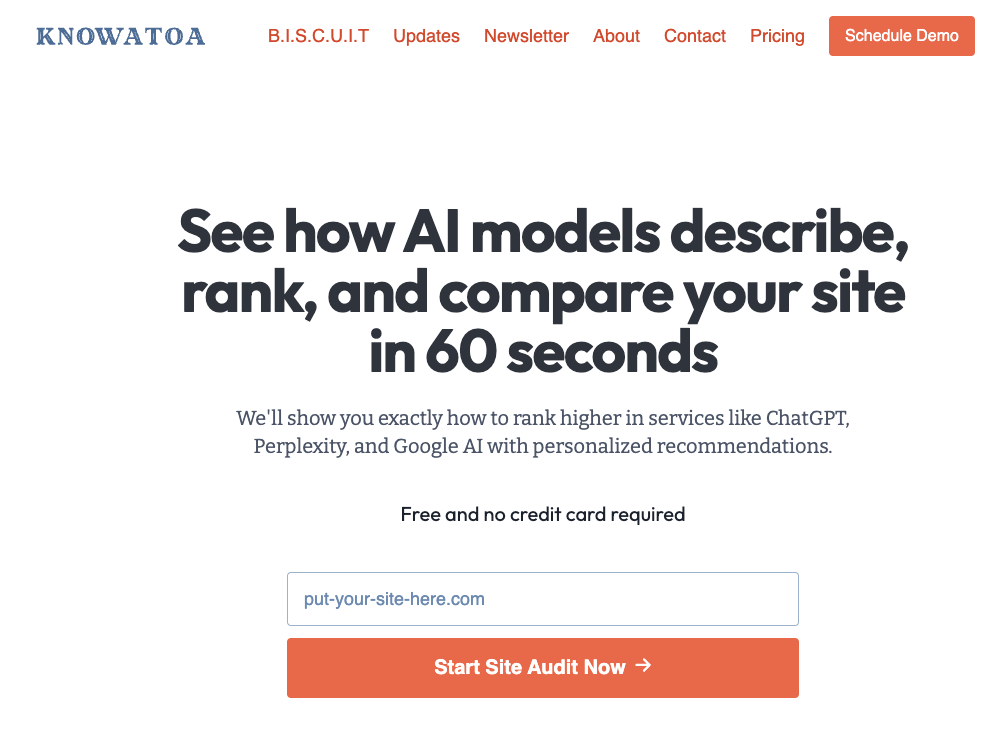
12. Knowatoa AI
Key Differentiators
Brand visibility tracking with competitor benchmarking focused on accurate descriptions and positive sentiment.
Best For
Agencies and in-house teams wanting straightforward monitoring without advanced optimization features.
Limitations
Platform maturity still developing.
13. Ahrefs Brand Radar

Key Differentiators
AI citation tracking integrated into Site Explorer alongside traditional SEO metrics.
Best For
Existing Ahrefs users seeking early AI visibility insights within current workflow.
Limitations
Limited sampling captures only fraction of conversations; Beta status means evolving features.
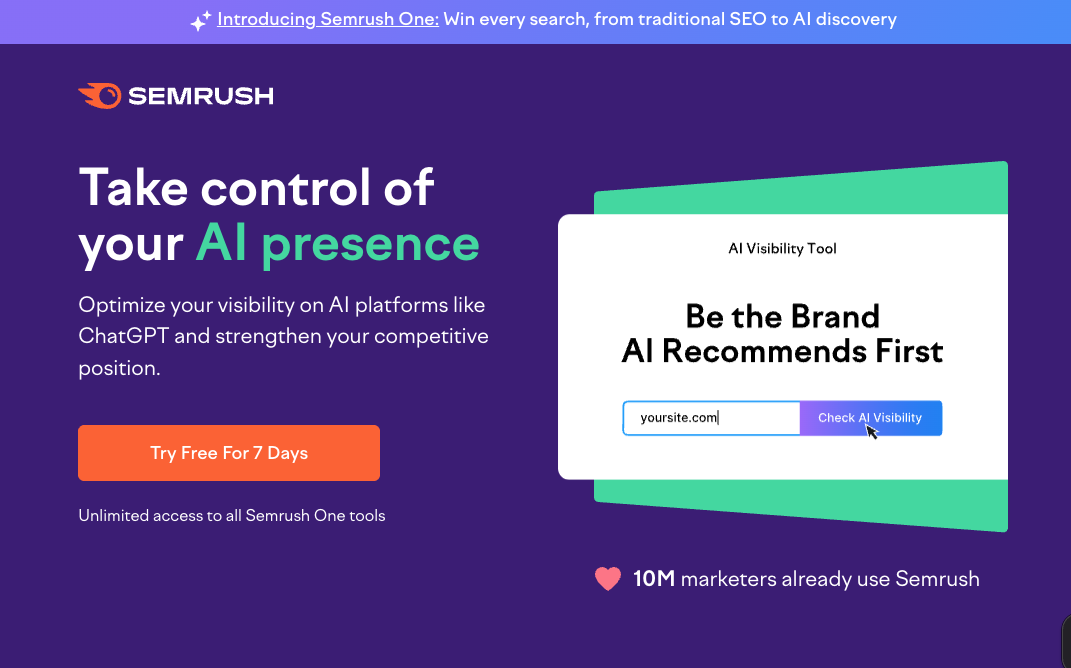
14. Semrush AI Toolkit
Key Differentiators
Brand perception analysis in ChatGPT and Google AI with sentiment tracking and Business Landscape reports.
Best For
Established brands and agencies heavily invested in Semrush who want AI insights without learning a new platform.
Limitations
Limited platform coverage—appears to only track ChatGPT, AI Mode, and AI Overviews as of November 2025. Recent Adobe acquisition likely means slower platform evolution as integration priorities shift.
15. HubSpot AEO Grader

Key Differentiators
Free tool that analyzes brand visibility, sentiment, and competitive positioning.
Best For
Businesses wanting initial AI visibility assessment without financial commitment; ideal for securing budget or demonstrating GEO need.
Limitations
Limited to snapshot audits rather than continuous monitoring. Lacks depth of enterprise platforms for ongoing optimization programs.
Conclusion: How to Choose Your GEO Platform
Prioritize a platform with clear methodology transparency, platform coverage matching your audience's AI usage patterns, and statistical significance for data-driven insights. The brands that will dominate AI search are the ones that act quickly on the insights they uncover, treat GEO as a strategic priority rather than a monitoring afterthought, and invest in the source influence that shapes AI recommendations over time. Here's a full buyer's guide to choosing the right GEO platform for your team.
Consider these factors:
1. Budget: Platforms range from $29/month (Otterly) thousands a month for enterprise solutions
2. Company Size: SMBs need different features than enterprises
3. Data Requirements: Statistical rigor varies significantly across platforms
Start with Evertune if you're serious about winning AI search. Its combination of unlimited competitor tracking, base model API access, statistical rigor, and source influence analytics delivers insights competitors simply cannot match. The battle-tested leadership brings operational maturity that other platforms lack. See how your brand performs in AI search today.
Frequently Asked Questions
What is AEO? What is GEO? What is AI Search Optimization?
GEO (Generative Engine Optimization), AEO (AI Engine Optimization), and AI Search Optimization are all terms used interchangeably to describe the practice of optimizing your online presence and content to improve how your brand appears in AI-generated responses. These practices focus specifically on influencing how generative AI models perceive, understand, and recommend your brand.
What is a citation?
In the context of AI-generated responses, a citation is a reference to a source that the AI model used to generate information in its response. Citations typically appear as links, footnotes, or inline references that direct users to the original content. Citations are important for understanding and optimizing your brand's AI visibility because they show which content AI models are using to form their knowledge about your industry, brand or competitors.
What does an LLM mean?
LLM stands for Large Language Model—a type of artificial intelligence trained on massive amounts of text data to understand and generate human-like language. LLMs are trained by reading billions of words from the internet, books, articles, and other text sources. Through this training, they learn patterns in language, facts about the world, and how to generate coherent, contextually relevant responses. The "large" in Large Language Model refers to the enormous amount of data and computational power used in training.
What's the difference between GEO and SEO?
While GEO (Generative Engine Optimization) and SEO (Search Engine Optimization) share similar goals—improving brand visibility—they optimize for fundamentally different systems and user experiences.
Key differences:
- SEO optimizes for search engine rankings; AEO optimizes for AI model knowledge and recommendations
- SEO focuses on keywords and backlinks; AEO focuses on comprehensive content that educates AI models
- SEO results appear as ranked links; AEO results appear as narrative recommendations within AI responses
Does ChatGPT give the same answer to everyone?
No, ChatGPT doesn't give identical answers to everyone. This is because AI models are predictive by nature. This variability is why Evertune tests millions of prompts - to understand how AI models respond at scale and identify consistent patterns in brand recommendations.
Evertune is the Generative Engine Optimization (GEO) platform that helps brands improve visibility in AI search by analyzing responses at scale and delivering actionable insights. Evertune works with leading brands across all verticals, including Finance, Retail and E-Commerce, Automotive, Pharma, Tech, Travel, Food and Beverage, Entertainment, CPG, and B2B. Founded by early team members of The Trade Desk, Evertune has raised $19M in funding from leading adtech and martech investors. Headquartered in New York City, the company has a growing team of more than 40 employees.
Don't forget to share this post


